insights

Product Deveopment Pocket Guide

Every successful health technology follows a path — from early concept through scale-up to marketlaunch. Understanding this journey helps teams anticipate challenges, make informed decisions, andmove confidently toward commercialization.
Overview
Bringing a medical device or diagnostic product to market isn't a straight line. It's a series of interconnected stages, each building on the last. Skip a step or rush through validation, and you risk costly setbacks. Move thoughtfully through each phase, and you create a foundation for long-term success.This guide breaks down the product development journey into three core stages, highlighting what matters most at each milestone. For teams navigating this path for the first time — or looking to refine their approach — these insights can help you think ahead and avoid common pitfalls.

The Three Stages of Product Development
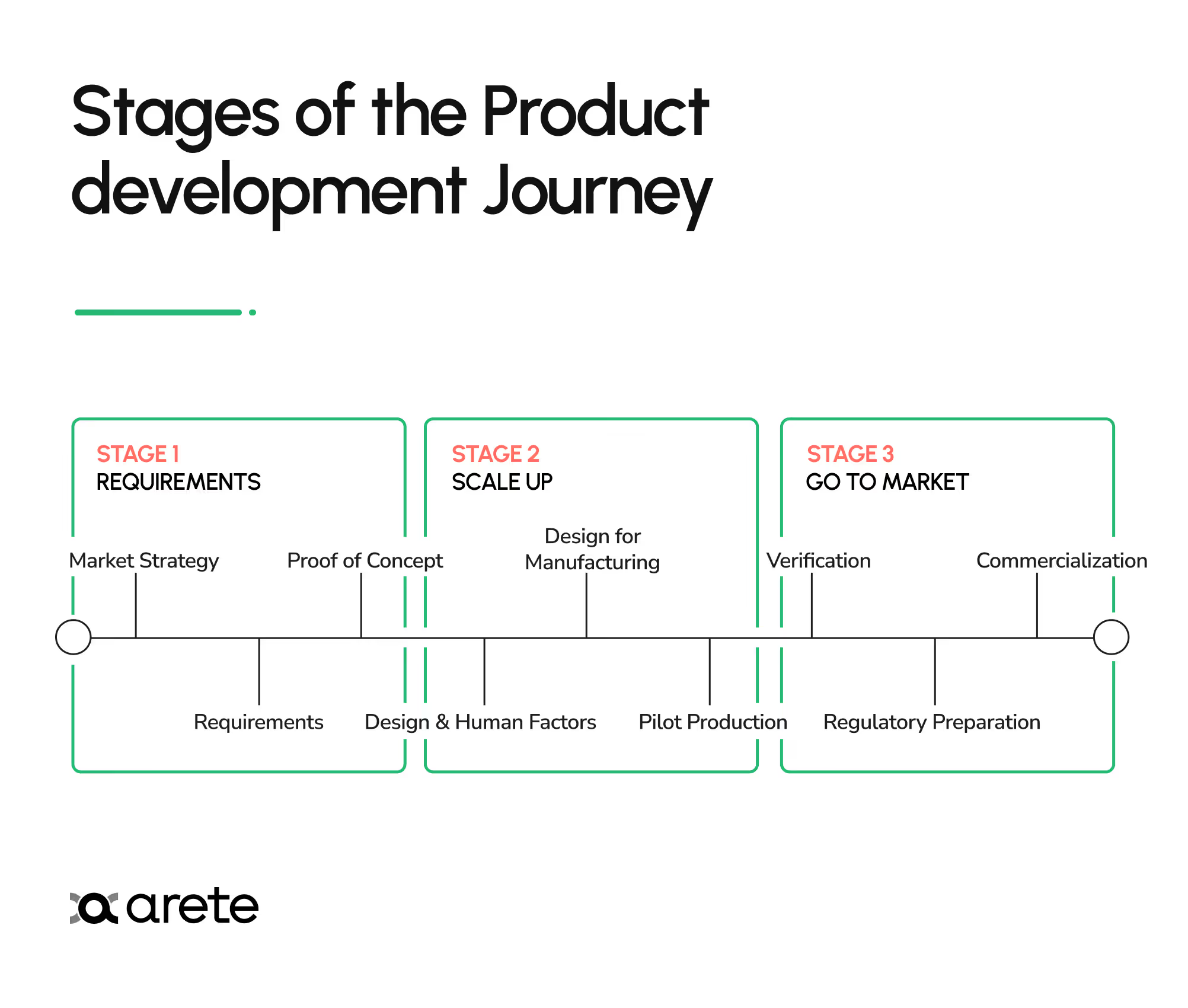
The journey from idea to market-ready product typically unfolds across three stages: Requirements, Scale Up, and Go to Market. Each stage has distinct objectives, and success in later phases depends on the groundwork laid earlier.
stage 1

Stage 1: Requirements

The first stage establishes your product's foundation. Before investing in prototypes or production planning, you need clarity on three fronts: the market opportunity, the product requirements, and whether the core technology can deliver.
1.1 Market Strategy
What problem is your product solving
Understanding the problem your product solves is where everything begins. Who is your customer? What unmet need does your solution address? How does it differentiate from existing options? Answering these questions early ensures your development efforts create real value — not just technical novelty.
1.2 Requirements Definition
What does your product need to create value?
Clear requirements align your entire team around what success looks like. This means defining performance expectations, usability needs, regulatory constraints, and cost targets before design work accelerates. Ambiguity here leads to confusion, scope creep, and rework later.
1.3 Proof of Concept
Can your core idea demonstrate real potential?
Testing your core idea early confirms whether the underlying technology can deliver on its promise. A focused proof-of-concept reveals technical challenges, reduces risk, and builds confidence before you commit significant resources. It's far better to discover limitations now than during verification testing.
stage 2

Stage 2: Scale Up

With requirements validated and feasibility confirmed, the focus shifts to building a product that works reliably — and can be manufactured at scale. This stage brings together scientific, engineering, and human factors disciplines into a unified system.
2.1 Integration
Do all components work together as one?
Integration is where individual components — assays, consumables, hardware, software — come together as a functional whole. This stage often exposes workflow gaps and interface issues that weren't visible when subsystems were developed separately. Strong cross-functional collaboration is essential here.
2.2 Design and Human Factors
Is your product intuitive, safe, and easy to use?
A product that performs well technically but frustrates users won't succeed in the market. Human-centered design ensures your product is intuitive, safe, and easy to use in real-world conditions. Early usability testing builds trust and reduces opportunities for use error — a critical consideration for regulatory submissions.
2.3 Design for Manufacturing
Can your product be built reliably and at scale?
Prototypes prove a concept works. Manufacturing proves it can be built consistently, efficiently, and at scale. Design for Manufacturing (DFM) simplifies assembly, defines critical tolerances, and anticipates maintenance needs. Investing in manufacturability now prevents quality issues and cost overruns later.
2.4 Pilot Production
Will your process perform beyond prototypes?
Pilot production tests whether your manufacturing process holds up beyond the prototype stage. It validates vendor reliability, confirms that processes scale appropriately, and highlights improvements needed before high-volume production begins. Think of it as a dress rehearsal for commercial manufacturing.
stage 3

Stage 3: Go to Market

The final stage transforms a validated design into a commercial product. This is where verification evidence, regulatory strategy, and launch planning converge to bring your innovation to the people who need it.
3.1 Verification and Validation
Does your product deliver accurate, consistent results?
Verification confirms that your product meets its design specifications. Validation confirms it meets user needs in real-world conditions. Together, they generate the evidence required for regulatory submission and market confidence. Testing with actual users and representative samples is essential — simulated conditions only take you so far.
3.2 Regulatory Preparation
How can preparation help streamline the process?
A smooth approval process doesn't happen by accident. Understanding FDA requirements, organizing your Design History File, aligning clinical trial plans, and ensuring quality system compliance all require deliberate preparation. Teams that treat regulatory strategy as an afterthought often face preventable delays.
3.3 Commercialization
Do you have the strategy needed to launch successfully?
Launch readiness extends beyond regulatory clearance. Successful commercialization aligns manufacturing capacity, field support systems, distribution channels, and market positioning. Clear differentiation, reliable customer support, and thoughtful planning set your product up for sustainable success — not just initial sales.
Moving Through the Journey
Product development rarely follows a perfectly linear path. Teams revisit earlier decisions, adapt to new information, and iterate based on testing results. That's expected — and healthy.

What matters is maintaining discipline throughout: documenting decisions, managing risk continuously, and keeping cross-functional teams aligned. The companies that navigate this journey most effectively aren't necessarily the ones with the biggest budgets. They're the ones that plan thoughtfully, collaborate well, and learn quickly from setbacks.
FAQ's

FAQs About Product Development

What are the main stages of product development?

Product development typically moves through three stages: Requirements (defining the problem, specifications, and proving feasibility), Scale Up (integrating components, refining design for manufacturing, and running pilot production), and Go to Market (verification testing, regulatory preparation, and commercialization). Each stage builds on the previous one, so thoroughness early prevents costly rework later.

How long does the product development process take?

Timelines vary significantly based on device complexity, regulatory classification, and technical challenges. Simple Class I devices might reach market in 12–18 months, while complex Class II or III devices often require 3–5 years. Strong planning, early risk identification, and integrated cross-functional teams can help compress timelines without cutting corners.

When should I involve regulatory and quality teams?

As early as possible. Teams that treat regulatory strategy as a late-stage activity often face preventable delays. Engaging QA/RA during requirements definition helps ensure design decisions align with submission expectations, documentation stays current, and risk management remains integrated throughout development.

What's the difference between verification and validation?

Verification confirms you built the product correctly — testing whether the device meets its design specifications. Validation confirms you built the right product — demonstrating that it meets user needs in real-world conditions. Both are essential for regulatory submissions and should involve representative users and samples.

Why do so many product development projects get delayed?

Common culprits include poorly defined requirements, underestimating regulatory complexity, late-stage design changes, supply chain issues, and inadequate documentation. Most delays trace back to insufficient work in early stages — rushed feasibility assessments or unclear specifications that create compounding problems downstream.

Should we build internal capabilities or partner with a development firm?

It depends on your team's expertise, timeline, and risk tolerance. Many startups and emerging companies partner with experienced development firms to access multidisciplinary capabilities — engineering, regulatory, quality, manufacturing — without building those functions internally. This can accelerate timelines and reduce risk, especially for teams navigating regulated development for the first time.

Partner With Arete Biosciences

Navigating product development requires expertise across multiple disciplines — science, engineering, regulatory, quality, and commercialization strategy. Arete Biosciences brings these capabilities together under one roof, helping health technology innovators move from concept to market with confidence.Whether you're validating a new diagnostic approach, scaling up manufacturing, or preparing for FDA submission, our team is here to help you anticipate challenges and keep development moving forward.Ready to discuss your project? Contact our team to explore how we can support your product development journey.
Innovate with lasting impact
We blend deep scientific understanding with commercialization expertise to deliver end-to-end services tailored to your vision, ensuring seamless progression from idea to solution.
Your vision is our passion
Just like you, we’re in this for the right reasons. We take pride in crafting realistic and impactful innovations from the sparks of your unique ideas.
Contact Us

Reach Out Today

Email:
info@aretebiosciences.com
Phone:
+1-858-326-5503
Office:
2270 Camino Vida Roble, # K, Carlsbad, CA 92011
Follow Us
Thank you! Your submission has been received!
Oops! Something went wrong while submitting the form.